


History

St Peter's and & St Thomas' Church
The lives of the early settlers in Sissiboo were interwoven with their religion and church life. For most, the church was and still is, an integral part of community activities. It is not surprising then that the building of village churches was looked upon as being important. This article will have two parts. The first will examine the developing of St. Peter’s Parish and the next part will examine the current St. Peter’s Church.
According to the Anglican church records, a land grant was made on August 1st 1783 by a committee formed by Governor Parr to establish a Glebe Lot. A Glebe Lot was usually about 1000 acres and granted to the Church of England, in colonial times, to be used as a source of revenue for the clergy. This Glebe Lot was situated on both sides of the road leading to Clare and intersected by the New Edinburgh Road. For various reasons, over the years this property was lost to the church.
Loyalists were those who had supported the British Crown during the American Revolution. When they lost the war, they were sent into exile and many arrived at Sissiboo in 1783. The few British inhabitants that were in Sissiboo, at that time, were mainly New England fishermen. Bishop Inglis, the first bishop in the colony, was not overly impressed with them and he wrote,
“The old settlers in this province are generally poor, .....a laxness of morals was of the want of a regular clergyman...... A spirit of industry has been introduced by the Loyalists and I found a general inclination to have Divine worship regularly according to the mode of our excellent church.”
The new settlers were just as eager to have a church and clergy as the bishop. The Loyalists at Sissiboo believed they were in danger of losing their religion by the Fanatic Teachers descending upon them from New England.
The first missionary at Sissiboo appears to be Reverend Roger Viets who was the rector of Trinity Anglican Church in Digby. He visited Sissiboo at least four Sundays a year from 1786 until 1795 on horseback. It is recorded that Reverend Viets baptized babies and two adults holding services in private homes as there was not a church at this time.
On June 15th,1790 a deed was drawn up by Col. James Moody “with his wife’s consent giving one and 3/8s acres of land for the sole purpose of erecting a church.”
Later, at a public meeting, James Moody, Stephen Jones and Col. John Taylor and one other Loyalist were appointed to supervise the building of the church. The Society of the Proclamation of the Gospel (S.P.G.) founded in England in 1701, was formed to help fledging Anglican churches in the colonies by providing them with exemplary clergymen, Bibles and prayer books. The S.P.G. allotted £200 pounds towards the building of the church. James Moody gave £15, John Taylor £7 and Stephen Jones gave £5. Fifteen members of the congregation stepped forward to help in other ways. Reubin Hankinson offered twelve days of labour, Benjamin McConnell offered six, and Cereno Jones offered five days of ox work. These members all had farms to look after so one can see this was a big commitment for them.
Within one year Bishop Charles Inglis was informed that the church in Sissiboo was raised and partly covered in. However, there were many obstacles to overcome such as, housing for the clergy and his stipend, before the bishop would send a regular minister.
The first St. Peter’s Church was a typical, colonial, wooden structure of the era. The church was rectangular, about 30 feet by 45 feet, white, with a sloping roof, a chancel and a steeple. The church could hold about 150-200 people on feast days, but the congregation would be less than 50 on a normal Sunday. St. Peter’s Church overlooked the Mill Pond where Cosman’s Creek flowed into. Although the church was operational, it would not be consecrated until June 1826. The first wardens of St. Peter’s were Col. James Moody and Captain John Grigg.
Then in 1801, the S.P.G. and Bishop Charles Inglis approved a minister, Reverend Charles Weeks, for St. Peter’s at Sissiboo. However, the new minister found ministering to his flock difficult. There were great distances between parishioners, roads were difficult and often little more than paths, dissension was evident and a strong Baptist enthusiasm was ingratiating itself in the community. However, it was the vestry meeting of 1806 when things got out of hand. Reverend Charles Weeks was probably no match for these strong willed Loyalists who had survived the American Revolution. He resigned and left for Guysboro Co., N.S.
There seems to have been neither a resident clergy nor any missionary work done in the parish from 1806 to 1823 until Reverend Alfred Gilpin arrived. It was at this time that the pews were rented or sold. One could be sued if the rent was not paid on the pew. Records reveal that £46 pounds was raised in 1823 from the sale of the pews. In June 1826, St. Peter’s Church was finally consecrated, along with the burial grounds by Bishop John Inglis. Reverend Charles Gilpin left many legacies to the church: one is the Gilpin Fund. This fund was to aid the clergy in the parishes of Wilmot, Weymouth and Yarmouth.
Then in 1836, the Reverend William H. Snyder arrived to minister to the communicants. He was the grandson of Col. John Taylor, a Loyalist who had helped to establish St. Peter’s Church and lived on the south side of the Sissiboo River. Col. Taylor’s large, Georgian residence is reported to be the oldest house in the area and is presently owned by the Belliveau family in Weymouth.
The second historical part of this parish begins with the ministry of the Reverend James Philip Filleul, D.D. He was born in 1817 at Jersey, Channel Islands and began his ministry at Weymouth in 1852. The name of Sissiboo was changed to Weymouth in 1823. Reverend Filleul was held in high esteem by all and accomplished a great deal in his forty years of ministry in the area. It was during his incumbency that four new churches in the area were built, including the present St. Peter’s Church.
Allen Gibson in his article,Churches by the Sea,states that Reverend Filleul’s
leadership in Weymouth was a period of great progress in the life of the church.
It was in 1854 that it was decided that a”set of registry books be purchased for the parish”. Until this time, the register was kept on pieces of paper sewn together. Most of which had been lost.
At a meeting of the parish vestry in April 1877, it was moved and seconded that in view of the dilapidated state of the church, immediate steps should be taken to replace the building. The church was to be taken down and sold at auction with the proceeds to be used for the new church. Such was the enthusiasm for the new St. Peter’s Church that it was ready to be consecrated November 18,1879.
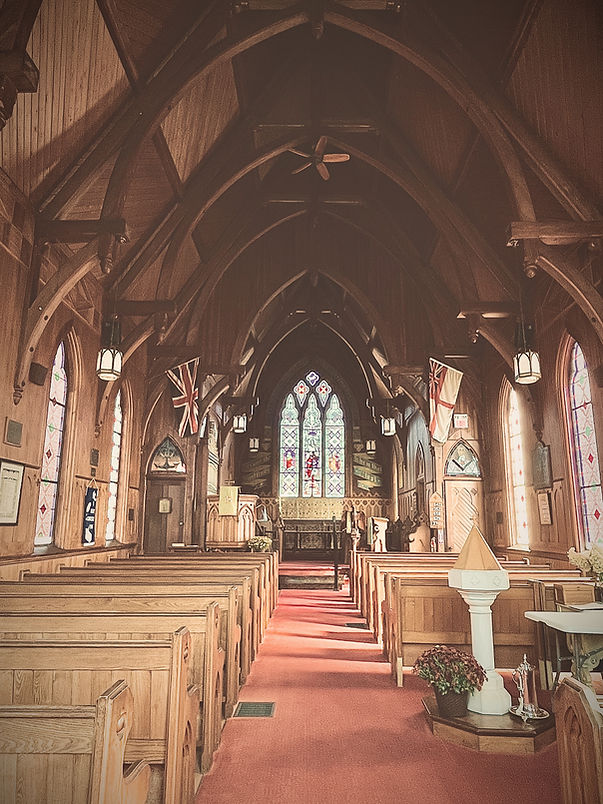
The current St. Peter’s Church is an active worshipping church and is in the same location of the first St. Peter’s Church. It is Gothic Revival interpreted in wood. This church is built on the pattern of British Parish churches with a nave, chancel and side aisles. The three stain glass Gothic Chancel windows above the altar depicting Biblical scenes were donated in memory of the Campbell, Jones’, and Taylor families.
The interior roof has supporting structures like the inverted ribs of a ship with large oak ribs arched to the peak. The panelled walls with detailed designs are finished in walnut. Memorials grace the walls in memory of the Taylor, Jones, Journeay, Campbell and Ruggles families. The only artifact from the original St Peter’s Church is the large clock purchased in 1858.
When a new church is consecrated, it is customary to give gifts. Some of the gifts given and still in use are:
-
The lectern by Colin Campbell, Esq.
-
The Chancel Rail by Norman Jones, Esq.
-
The Bishop’s Chair, by Wentworth Moody, in memory of Col. James Moody,
-
The Sedilia by Sydney St Claire Jones.
-
The Altar by communicants.
-
The Credence Table by His Lordship , Bishop Binney.
-
The Pulpit by Charles Burrill.
-
The Font by Mr. H.L. Jones.
A pipe organ was purchased in 1885 and a furnace installed in the cellar in 1893.
At the Easter Vestry meeting of 1892, Dr. Filleul resigned due to ill health after forty years of faithful service. The parishioners gave him the use of the rectory during his life time. He died January 24th,1902 and is buried at St. Peter’s Cemetery, Weymouth North.
St. Thomas Church built in Weymouth about 1860 was deconsecrated by Bishop L.F. Hatfield on April 17th,1977. The name of the current Parish Church was then changed to the Church of St. Peter and St. Thomas.
This parish, by the grace of God, and the parishioners, has provided comfort, guidance, and spiritual growth for nearly two and a half centuries in our community. What a Loyalist legacy!
Written by: Roberta Journeay
References:
Shenstone, Susan Burgess, So Obstinately Loyal James Moody 1744-1809. Published for Carlton University by McGill-Queen’s University Press, Montreal& Kingston. 2000.
Ruggles, C.R. A Short History of St. Peter’s Parish. Weymouth,N.S. 1965.
The Parish of St. Peter’s &St Thomas: An Historical Sketch. 2023.
Gibson,M.Allen. Churches by the Sea. The Chronicle Herald. March1,1975.




Loyalist Col. James Moody
The Original St. Peter's Church (left) and the new St. Peter's Church (right)
Chancel and Sanctuary of St. Peter's Church
St. Peter's Church Interior